
Margin Trading Facility (MTF) allows eligible investors to purchase shares by paying only a portion of the total transaction value while their broker finances the remaining amount. In India, MTF is a regulated facility offered by eligible stockbrokers subject to applicable Securities and Exchange Board of India (SEBI) and stock exchange requirements.
For investors who want to take a larger position without paying the entire purchase price upfront, MTF can provide additional flexibility. However, it is not free money or a guaranteed way to increase profits. The borrowed amount generally attracts interest, and losses can become larger relative to the investor’s own contribution.
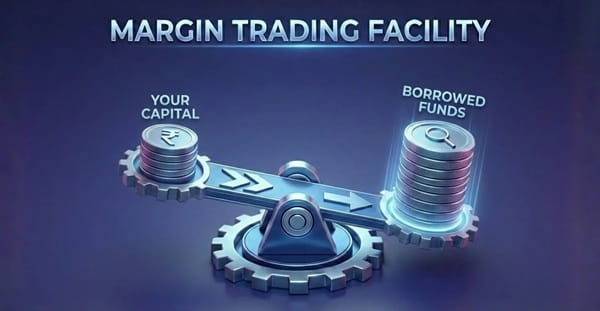
Understanding what MTF actually lets you do, how it works, and what risks it creates is essential before using it.
What Is Margin Trading Facility?
Margin Trading Facility is a service through which a broker finances part of an eligible share purchase, while the investor contributes the required margin from their own funds. The purchased securities and other permitted collateral may be subject to applicable pledge, funding, and risk-management arrangements.
For example, suppose an investor wants to buy shares worth ₹1,00,000. If the applicable margin requirement is 40%, the investor would contribute ₹40,000, while the broker could finance the remaining ₹60,000, subject to the facility’s terms and regulatory limits.
The investor would hold a position worth ₹1,00,000 despite contributing only ₹40,000 initially. However, the investor remains responsible for the funded amount, interest, applicable charges, and losses.
Actual margin requirements depend on the security, broker, applicable regulations, and market conditions. The example is illustrative rather than a universal MTF rule.
What Does MTF Actually Let You Do?
Buy More Shares With Available Capital
The main benefit of MTF is that it can increase the value of shares an investor can purchase with a given amount of personal capital.
Without borrowing, ₹40,000 would ordinarily buy shares worth approximately ₹40,000 before charges. With an illustrative 40% margin requirement, the same contribution could support a ₹1,00,000 position.
This increased exposure is commonly described as leverage. It can make capital available for other purposes, but it also increases the effect of price movements on the investor’s own funds.
Hold Eligible Shares Beyond Intraday Trading
MTF can allow investors to carry eligible financed share positions beyond the trading session, subject to the broker’s conditions and applicable rules. This differs from certain intraday trading arrangements, where positions generally need to be closed within the same trading day.
The facility may therefore suit investors who want to take a short-term or medium-term position but do not wish to pay the full purchase price immediately.
However, MTF is not identical to buying shares outright with personal funds. The investor must account for financing costs, margin requirements, and the possibility that the broker may require additional funds.
Use Capital More Flexibly
Because the investor does not pay the entire purchase value upfront, some capital may remain available for other financial needs or investments.
Nevertheless, unused cash should not automatically be treated as spare money. The investor may need it to meet margin calls, cover losses, or maintain the position if the share price declines.
Using MTF across several positions can also increase overall portfolio exposure. If multiple holdings fall at the same time, the investor may face pressure to add funds or reduce positions.
How MTF Works in Practice
When an investor places an MTF order, the broker checks whether the security is eligible and calculates the required margin. The investor provides the specified contribution, and the broker finances the remaining eligible amount under the facility’s terms.
The purchased shares are generally subject to a pledge in favour of the broker or another permitted arrangement. The investor must meet ongoing margin requirements and pay interest on the funded amount.
Consider a simplified example:
| Particulars | Amount |
| Total share purchase | ₹1,00,000 |
| Investor’s contribution | ₹40,000 |
| Broker-funded amount | ₹60,000 |
| Share value after a 10% rise | ₹1,10,000 |
| Share value after a 10% fall | ₹90,000 |
If the share value rises to ₹1,10,000, the position gains ₹10,000 before interest and other costs. If it falls to ₹90,000, the position loses ₹10,000 before costs. In both cases, the broker-funded amount remains payable, subject to the facility’s terms.
The gain or loss therefore represents 25% of the original ₹40,000 contribution, before charges, even though the share price moved by only 10%. This illustrates how leverage magnifies returns and losses relative to the investor’s own capital.
What Are the Costs of MTF?
MTF typically involves interest on the amount financed by the broker. The interest rate, charging method, and applicable holding-period conditions vary by broker.
Investors may also pay brokerage, securities transaction tax, exchange charges, GST, stamp duty, and other applicable transaction costs. These expenses can reduce profits or increase the overall cost of a losing trade.
Before using MTF, check the broker’s published interest rates, margin requirements, eligible securities list, and policies for shortfalls or forced liquidation. A position that remains open for an extended period can accumulate substantial financing costs, even if its share price does not change significantly.
What Are the Main Risks?
Magnified losses: A relatively small decline in share prices can cause a much larger percentage loss on the investor’s contribution.
Margin calls: If the value of the position falls or margin requirements change, the broker may require additional funds or eligible collateral.
Forced liquidation: If a margin shortfall is not addressed within the applicable timeframe, the broker may sell securities to reduce its exposure, potentially at an unfavourable price.
Interest costs: Financing expenses continue according to the agreed terms and can make a marginally profitable trade unprofitable.
Market volatility: Sudden price movements can create losses faster than an investor can respond. A stop-loss order may not execute at the intended price during a sharp market move.
MTF is therefore unsuitable for investors who cannot afford potential losses or who need their invested funds for essential expenses.
Is MTF Suitable for Every Investor?
No. MTF may be useful for experienced investors who understand leverage, can monitor their positions, and have sufficient financial resources to meet additional margin requirements.
Investors who prefer to avoid borrowing costs and financing-related obligations may find fully paid share purchases more suitable. Beginners should first understand market orders, volatility, portfolio risk, and basic position sizing before considering leveraged investments.
The decision should be based on the investment objective, holding period, security fundamentals, financing costs, and ability to absorb losses—not simply on how much additional buying power a broker offers.
Conclusion
Margin Trading Facility allows eligible investors to purchase shares using a combination of personal funds and broker financing. It can increase buying power and support positions held beyond intraday trading, but it also introduces interest expenses, margin obligations, and the risk of forced liquidation.
The most important point is that MTF increases exposure, not certainty. Before using it, understand the broker’s terms, calculate the full cost of financing, and consider how a price decline would affect your finances. Leverage should be approached cautiously, with a clear risk-management plan and no assumption that market prices will move in your favour.
Frequently Asked Questions
Q. What does Margin Trading Facility actually let you do?
MTF allows eligible investors to purchase approved shares by paying the required margin while their broker finances part of the purchase value.
Q. Can I hold MTF shares overnight?
Yes, MTF is designed to support eligible financed positions beyond the trading session, subject to the broker’s terms and applicable regulations.
Q. Do I have to pay interest on MTF?
Generally, yes. Interest is charged on the funded amount according to the broker’s terms. Check the applicable rate and charging method before using the facility.
Q. Can I lose more than my initial margin in MTF?
Yes, losses and other obligations can exceed the initial contribution, depending on price movements, charges, and the facility’s terms. Investors should not assume that their initial margin is the maximum possible loss.
Q. Can a broker sell my MTF shares without my permission?
A broker may liquidate positions under the applicable agreement and rules if margin requirements are not met or other specified conditions arise. Review the broker’s liquidation policy carefully.
Q. Is MTF the same as intraday trading?
No. Intraday trading generally involves positions intended to be closed within the same trading session. MTF can support eligible financed share positions held beyond that session, subject to applicable conditions.
Q. Is MTF suitable for beginners?
Beginners should be cautious because leverage increases financial risk and adds financing costs. Understanding the facility and being able to absorb potential losses are important before using it.
 BPCTeam