
Entering the stock market for the first time can feel confusing. Beginners must learn how prices move, how orders work, how to analyse charts, and how to manage potential losses. Making mistakes with real money during this learning process can be expensive. This is where paper trading becomes useful.
Paper trading allows individuals to practise buying and selling financial instruments using simulated money instead of their actual funds. It helps beginners understand market mechanics, test trading strategies, and develop decision-making skills without directly risking their savings.
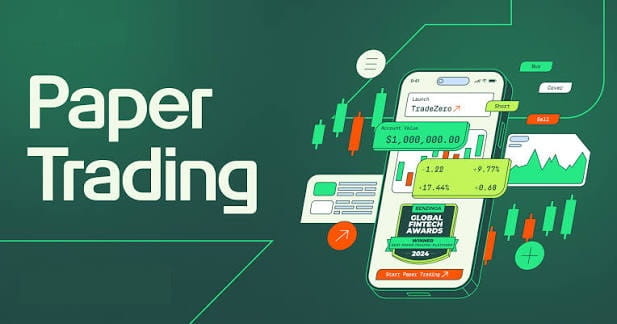
Although paper trading cannot perfectly reproduce real trading conditions, it provides a practical starting point for anyone who wants to learn about financial markets before committing capital.
What Is Paper Trading?
Paper trading is a simulated trading activity in which a person records or executes hypothetical trades using virtual funds. The purpose is to practise trading decisions without placing actual orders with real money.
Traditionally, traders recorded hypothetical entry and exit prices on paper. Today, many trading platforms offer virtual portfolios, simulated order books, and practice accounts that resemble real trading interfaces.
For example, a beginner might receive a virtual balance of ₹1,00,000. They could use this balance to simulate buying shares worth ₹20,000, monitor price changes, and calculate hypothetical profits or losses.
If the shares increase in value, the simulated account shows a gain. If their prices decline, the account reflects a loss. Because no actual capital is invested, the learner can practise the process without losing money on those simulated trades.
Paper trading is available for different market instruments, depending on the platform. These may include stocks, exchange-traded funds, futures, options, and foreign exchange products.
How Does Paper Trading Work?
The process generally begins with selecting a platform that supports simulated trading. Some platforms provide virtual balances and simulated order execution, while others require users to record trades manually.
After setting up an account, the trader selects an instrument and identifies a potential trading opportunity. They then choose an entry price, position size, and intended exit conditions.
For instance, a beginner might simulate purchasing 10 shares at ₹500 each, creating a hypothetical position worth ₹5,000. If the share price rises to ₹530, the gross simulated gain would be ₹300. If the price falls to ₹480, the hypothetical loss would be ₹200.
These calculations exclude transaction costs and assume execution at the stated prices. A realistic practice routine should account for brokerage, taxes, spreads, and slippage where applicable.
The trader should record the reason for entering the position, monitor its progress, and review the result after closing it. Repeating this process helps build familiarity with market behaviour and trading decisions.
Why Beginners Should Start With Paper Trading
Learn Market Basics Without Financial Risk
One of the main benefits of paper trading is that beginners can learn how markets function without putting their savings at risk.
They can practise reading price charts, understanding bid and ask prices, placing market and limit orders, and observing how prices respond to market news.
This practical experience complements theoretical learning. Instead of simply reading about trading concepts, beginners can see how those concepts work in a simulated environment.
However, paper trading does not remove every risk from the learning process. It can still encourage unrealistic expectations if the simulation does not accurately represent actual market conditions.
Test Strategies Before Using Real Money
Paper trading allows beginners to evaluate potential strategies before committing funds.
For example, a learner might test a moving-average crossover strategy or practise identifying support and resistance levels. By recording multiple trades, they can assess whether the approach performs consistently under different conditions.
It is important to test a strategy across a meaningful number of trades rather than judging it by a few successful outcomes. Trading costs, market conditions, and the possibility of random results should also be considered.
A strategy that appears profitable in a simulation may perform differently when used with real money.
Develop Risk Management Skills
Successful trading requires more than finding opportunities. Traders must also decide how much capital to expose, where to exit losing positions, and how to avoid excessive risk.
Paper trading provides an opportunity to practise these decisions. Beginners can calculate position sizes, set hypothetical stop-loss levels, and establish daily loss limits.
They can also learn why risking too much on a single trade can damage a portfolio. Building these habits in a simulated environment may make it easier to follow a structured plan later.
Build Confidence and Discipline
New traders often feel uncertain when using a trading platform for the first time. Paper trading can reduce this uncertainty by allowing them to practise repeatedly.
It also provides an opportunity to maintain a trading journal. Recording entry reasons, exit decisions, profits, losses, and mistakes helps learners identify patterns in their behaviour.
However, confidence should come from understanding a strategy and following a consistent process, not simply from achieving a series of simulated profits.
What Paper Trading Cannot Teach You Completely
Despite its benefits, paper trading has important limitations.
Emotional differences: Losing virtual money does not create the same emotional pressure as losing actual savings. Real trading can trigger fear, greed, hesitation, or impulsive decisions.
Execution differences: Simulated orders may fill at prices that would not have been available in a live market. This is especially important for fast-moving or illiquid instruments.
Incomplete costs: Some simulations may not accurately include brokerage, taxes, spreads, slippage, and other charges.
Changing market conditions: A strategy that performs well during one period may fail when volatility, liquidity, or market trends change.
For these reasons, paper trading should be treated as a learning tool rather than proof that a trader is ready to earn consistent profits.
How to Make Paper Trading More Effective
Start with a clear objective. Decide whether you want to learn order placement, understand chart patterns, or test a specific strategy.
Use realistic position sizes and maintain a written trading plan. Record every simulated trade, including the entry price, exit price, reasoning, risk level, and result after estimated costs.
Review your performance regularly. Look beyond total profit and examine average wins and losses, the frequency of rule violations, and the conditions under which the strategy performs poorly.
Avoid switching strategies after every losing trade. Instead, gather sufficient evidence before making adjustments. Once you understand the limitations of the simulation and can follow your rules consistently, you can assess whether a cautious transition to real trading is appropriate. Never use money needed for essential expenses.
Conclusion
Paper trading is a practical starting point for beginners who want to understand financial markets before risking real money. It helps develop familiarity with trading platforms, test strategies, practise risk management, and build disciplined habits.
However, simulated performance does not guarantee live results. Differences in execution, transaction costs, liquidity, and emotional pressure can significantly affect actual trading outcomes.
The most effective approach is to use paper trading as a structured learning process. Focus on understanding decisions, recording results, and correcting mistakes rather than chasing virtual profits. These habits can provide a stronger foundation for making informed decisions when considering real-money trading.
Frequently Asked Questions
Q. Is paper trading completely free?
Many platforms offer free simulated trading, although some advanced tools or data services may require payment. Check the platform’s terms before signing up.
Q. Can beginners make real money through paper trading?
No. Paper trading uses simulated funds, so its profits and losses are hypothetical. It is designed for practice rather than earning actual income.
Q. How long should I practise paper trading before using real money?
There is no fixed period. Focus on understanding order types, following a consistent strategy, managing risk, and reviewing a meaningful sample of trades before considering live trading.
Q. Is paper trading accurate?
It can be useful for learning and strategy testing, but simulated execution may differ from live trading because of spreads, slippage, liquidity, and other factors.
Q. Can I practise options trading through paper trading?
Yes, if the platform supports options simulation. However, options have additional complexities, including time decay, implied volatility, and the Greeks, which should be understood before live trading.
Q. Does paper trading guarantee success in the stock market?
No. It helps build skills but cannot eliminate market uncertainty or guarantee profits. Live trading involves financial and emotional challenges that simulations may not reproduce.
Q. What is the difference between paper trading and backtesting?
Paper trading generally involves practising trades in a simulated environment using current or live market prices. Backtesting evaluates a strategy against historical data to estimate how it might have performed in the past.
 BPCTeam